What Is Artificial Intelligence (AI)? Definition, Types, Examples & How It Works
Artificial Intelligence (AI) has moved from science fiction into everyday life. Whether you’re unlocking your phone with facial recognition, asking a virtual assistant a question, receiving personalized shopping recommendations, or using an AI chatbot to draft an email, you’re already interacting with AI.
Despite its growing presence, many people still wonder: What is Artificial Intelligence?

In simple terms, Artificial Intelligence is the ability of computer systems to perform tasks that normally require human intelligence. These tasks include learning, reasoning, recognizing patterns, understanding language, solving problems, and making decisions.
This guide explains what AI is, how it works, the different types of AI, where it’s used, its benefits and challenges, and why it has become one of the most important technologies of the modern era.
Artificial Intelligence (AI) is a branch of computer science that enables machines to perform tasks that typically require human intelligence, such as learning, reasoning, recognizing patterns, understanding language, and making decisions.
Today, AI powers technologies like ChatGPT, Google Search, recommendation systems, voice assistants, fraud detection systems, and many other everyday applications.
Key Takeaways
• Artificial Intelligence enables computers to perform human-like tasks.
• Machine Learning is one of the core technologies behind modern AI.
• Most AI systems today are Narrow AI.
• AI is transforming industries such as healthcare, finance, education, and manufacturing.
• Responsible AI requires transparency, fairness, and human oversight.
What is Artificial Intelligence?
Artificial Intelligence (AI) is a branch of computer science focused on building systems that can perform tasks traditionally associated with human intelligence.
These tasks include:
- Learning from data
- Recognizing images and speech
- Understanding natural language
- Making predictions
- Solving problems
- Automating decisions
AI Definition in Simple Words
Imagine teaching a computer by showing it thousands of examples instead of writing every rule manually. Over time, the computer learns patterns and can make predictions or decisions on new information. That’s the foundation of modern AI.
A Brief History of Artificial Intelligence
The Early Years
The concept of intelligent machines dates back centuries, but AI became a formal field in the 1950s. Researchers believed computers could eventually simulate aspects of human intelligence.
AI Winters
Progress slowed during periods when computing power and available data were insufficient, leading to reduced funding and interest.
The Deep Learning Revolution
Advances in computing hardware, large datasets, and neural network research enabled AI to achieve breakthroughs in image recognition, speech recognition, and language understanding.
The Rise of Generative AI
The latest wave of AI can generate text, images, audio, video, and software code, making AI accessible to individuals and businesses worldwide.
How Artificial Intelligence Works
Modern AI systems generally follow these steps:
- Collect data.
- Clean and organize the data.
- Train a machine learning model.
- Evaluate performance.
- Make predictions or generate outputs.
- Improve continuously using new data.
Core Components
Data: The foundation of AI.
Algorithms: Mathematical methods used to learn patterns.
Machine Learning: Enables systems to improve without explicit programming for every scenario.
Neural Networks: Layers of interconnected nodes inspired by the human brain that excel at recognizing complex patterns.
Inference: Applying a trained model to new data to produce predictions or responses.
Although AI systems can become more accurate over time as they learn from data, the quality of their outputs depends heavily on the quality of the data they are trained on.
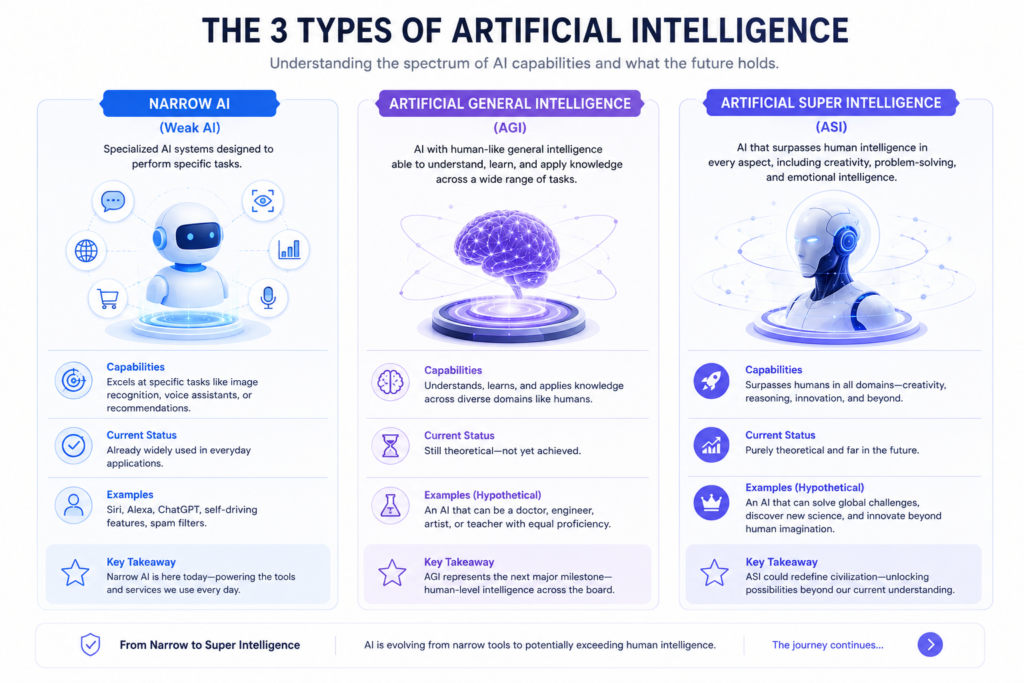
Types of Artificial Intelligence
| Type | Description | Current Status |
| Narrow AI | Performs specific tasks | Widely used today |
| General AI | Human-level intelligence across domains | Not yet achieved |
| Super AI | Exceeds human intelligence | Theoretical |
Most AI used today is Narrow AI, designed for specialized tasks such as recommendation systems, language translation, or medical image analysis.
Machine Learning vs Artificial Intelligence
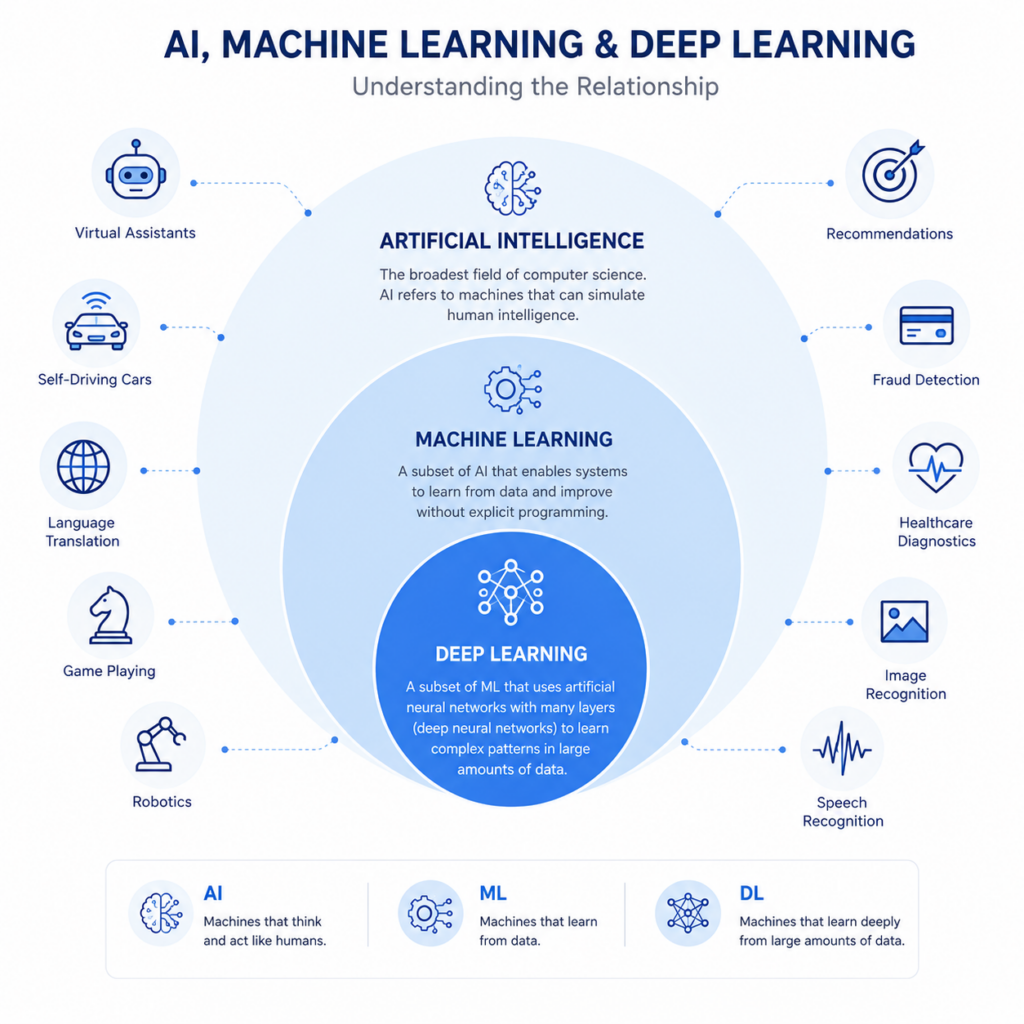
| Artificial Intelligence | Machine Learning |
| Broad field | Subset of AI |
| Focuses on intelligent behavior | Focuses on learning from data |
| Includes rule-based systems and learning systems | Relies on statistical models and algorithms |
| Encompasses multiple techniques | One approach within AI |
Applications of Artificial Intelligence
AI is transforming nearly every industry.
Healthcare
- Medical imaging analysis
- Drug discovery
- Patient monitoring
- Administrative automation
Finance
- Fraud detection
- Credit scoring
- Risk assessment
- Algorithmic trading
Education
- Personalized learning
- Automated grading
- Intelligent tutoring
Retail
- Product recommendations
- Demand forecasting
- Inventory optimization
Manufacturing
- Predictive maintenance
- Quality inspection
- Robotics
Cybersecurity
- Threat detection
- Anomaly detection
- Automated incident response
Transportation
- Driver assistance
- Route optimization
- Fleet management
Marketing
- Audience segmentation
- Content recommendations
- Campaign optimization
Customer Support
- AI chatbots
- Virtual assistants
- Automated ticket routing
Real-Life Examples of AI
AI powers many services people use every day, including:
- Email Spam Filtering
- AI automatically identifies unwanted emails and separates them from your inbox.
- Voice Assistants
- Assistants like Siri and Google Assistant use AI to understand voice commands and answer questions.
- Personalized streaming recommendations
- Language translation
- Navigation apps
- Image recognition
- AI writing assistants
- Customer service chatbots
Popular AI Tools
Some of the most widely used AI tools include:
• ChatGPT
• Claude
Benefits of Artificial Intelligence
Increased Productivity
AI automates repetitive tasks, allowing people to focus on higher-value work.
Better Decision-Making
AI analyzes large volumes of data quickly to identify trends and insights.
Improved Customer Experience
Personalized recommendations and faster support improve user satisfaction.
Cost Savings
Automation reduces operational costs and minimizes manual effort.
Innovation
AI enables new products, services, and scientific discoveries.
Businesses also use AI to improve operational efficiency, automate repetitive workflows, and deliver more personalized customer experiences.
AI automates repetitive and time-consuming tasks, allowing employees and businesses to focus on strategic and creative work.
Challenges and Risks
While AI offers significant opportunities, it also introduces challenges:
- Bias in training data
- Privacy concerns
- Security vulnerabilities
- Hallucinated or inaccurate outputs
- Workforce disruption
- Ethical considerations
- High energy consumption for some large-scale AI systems
Responsible AI development requires transparency, fairness, human oversight, and appropriate governance.
The Future of Artificial Intelligence
Several trends are shaping the future of AI:
- More capable AI agents that can complete multi-step tasks
- Multimodal systems that understand text, images, audio, and video together
- Greater use of AI in healthcare and scientific research
- Wider adoption in education and business operations
- Increased focus on AI safety, regulation, and responsible deployment
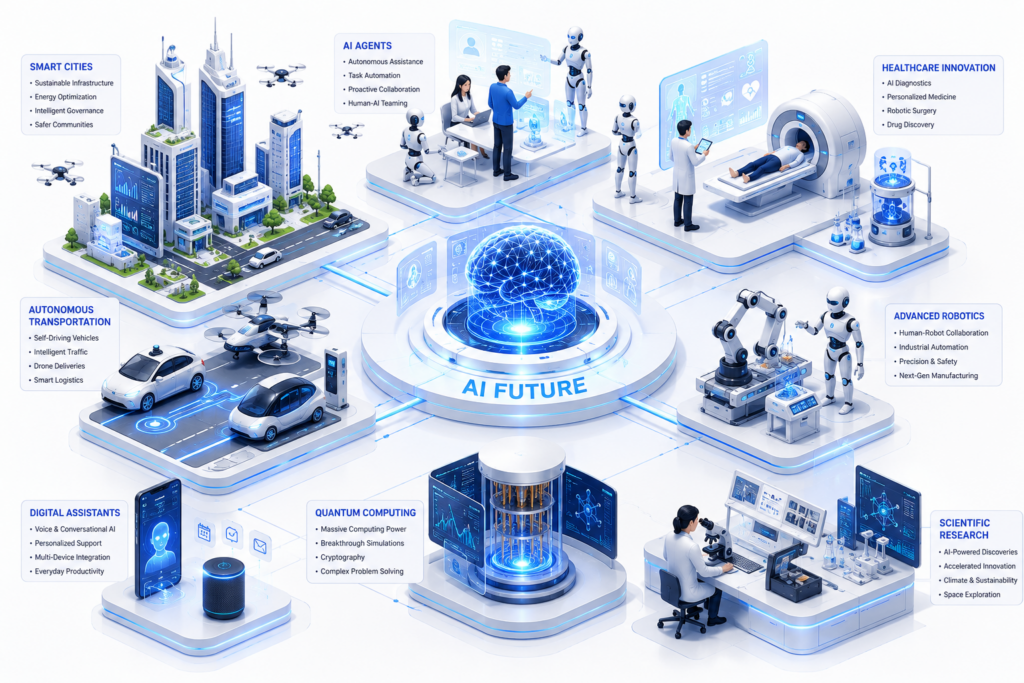
As AI becomes more integrated into everyday life, understanding its capabilities and limitations will be an increasingly valuable skill.
Frequently Asked Questions
What is Artificial Intelligence in simple words?
Artificial Intelligence is technology that enables computers to perform tasks that usually require human intelligence, such as learning, reasoning, and understanding language.
Is ChatGPT an example of AI?
Yes. ChatGPT is a generative AI application that can understand and generate human-like text.
Can AI think like humans?
Current AI systems do not think or possess consciousness. They identify patterns and generate outputs based on data and learned statistical relationships.
Will AI replace jobs?
AI is expected to automate some tasks while creating new roles and changing the nature of many existing jobs. Many experts anticipate increased demand for skills related to working with AI.
What is Generative AI?
Generative AI refers to models that can create new content, including text, images, audio, video, and code, based on prompts and learned patterns.
How can beginners start learning AI?
Start with foundational concepts such as mathematics, programming (especially Python), data analysis, machine learning, and practical projects using AI tools.
Conclusion
Artificial Intelligence is no longer a niche technology—it is transforming industries, businesses, and everyday life. By understanding its fundamentals, you can better appreciate its opportunities, limitations, and future impact.
Whether you’re a student, professional, or business owner, learning AI today will help you prepare for tomorrow’s technology-driven world.
Continue Learning
• What is Machine Learning?
• What is Deep Learning?
• Types of Artificial Intelligence
• AI vs Machine Learning
• What is ChatGPT?
• What is Generative AI?
References
The information presented in this guide is based on publicly available resources from recognized organizations in artificial intelligence and computer science.
1. IBM – Artificial Intelligence Overview
2. Google AI
3. Microsoft AI
4. Stanford Human-Centered AI (HAI)
5. OpenAI