Every executive and technical manager is being tasked with integrating AI into their operations. However, treating Large Language Models (LLMs) as magical “black boxes” leads to misaligned expectations, unreliable software outputs, and severe data security risks.
To leverage generative AI effectively, teams must transition from passive users to informed strategists. This guide diagnoses the core architectural mechanics of LLMs, provides a framework for evaluating top enterprise models, and delivers actionable solutions to the industry’s biggest challenges: hallucinations, latency, and context degradation.
1. The Core Engineering Challenge: How LLMs Actually Work
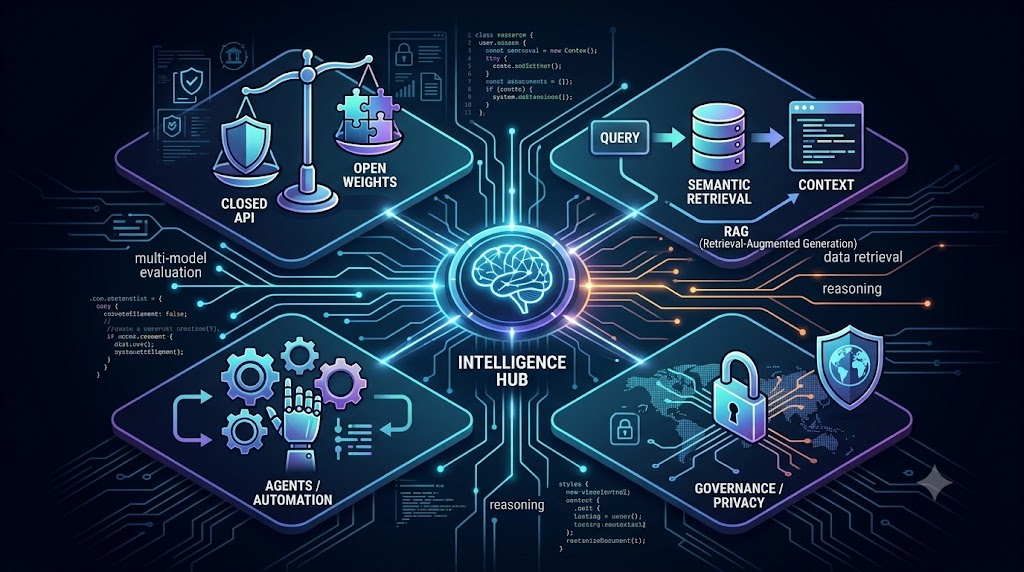
The primary operational risk in adopting LLMs stems from a fundamental misunderstanding: LLMs are not knowledge databases; they are statistical inference engines.
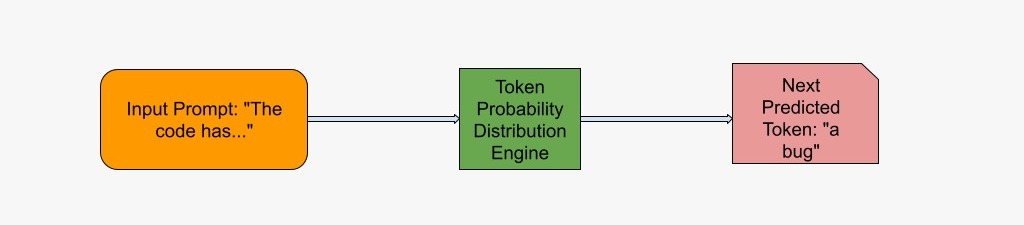
When an enterprise system queries an LLM, the model executes a three-part pipeline to generate output:
A. Sub-Word Tokenization
LLMs do not process raw text or full words. Inputs are fragmented into numerical representations called tokens (roughly 0.75 words per token in English). Processing text as token IDs allows the model to handle typos, code syntax, and complex technical vocabulary efficiently.
B. Self-Attention Mechanics (The Transformer)
Traditional neural networks struggled with long text because they read sequentially. Modern LLMs use Transformer Architecture with multi-head self-attention. This mechanism dynamically weighs the relationships between all tokens in a prompt simultaneously—allowing the model to correlate a variable introduced at the start of a context window with a function at the end.
C. Probabilistic Sampling
Instead of retrieving pre-written responses, the model calculates the mathematical probability of the next sequence of tokens based on patterns learned during pre-training. Parameters like Temperature control output variability:
- Temperature ~ 0.0: Deterministic, highly predictable output (ideal for code generation, data extraction, and financial calculations).
- Temperature ~ 0.7+: High variance, creative output (ideal for brainstorming and creative drafting).
2. Model Selection: Enterprise Comparison Matrix
Selecting the right foundation model requires balancing capability against latency, cost, and hosting privacy.
| Model Family | Architectural Focus | Primary Business Use Cases | Key Limitation |
| OpenAI (GPT-4o / Reasoning Series) | High-complexity logic, tool integration, multimodal reasoning | Autonomous workflows, complex code refactoring, enterprise agents | Closed-source; subject to vendor rate limits and pricing structure |
| Google DeepMind (Gemini) | Massive multi-million token context, native multimodal execution | Deep research, repository-scale codebase ingestion, document analysis | Strict API safety filters can occasionally cause over-refusal |
| Anthropic (Claude) | Highly nuanced prose, complex system instructions, agentic tasks | Technical documentation, contract review, long-form human synthesis | Higher latency on top-tier models compared to lightweight variants |
| Meta (Llama 3 / Open-Weight) | Self-hosted, fine-tunable, localized data governance | Private enterprise search, air-gapped deployments, custom vertical tasks | Requires internal DevOps infrastructure and GPU memory planning |
3. Solving the 3 Major LLM Deployment Problems
Deploying LLMs in production environments presents technical hurdles that can break consumer-facing application logic. Here is how to solve them.
Problem 1: Model Hallucinations (Fact Fabrications)
- The Root Cause: LLMs prioritize fluid, grammatically probable text over factual accuracy. If facts are missing from their parameters, they generate statistically plausible fabrications.
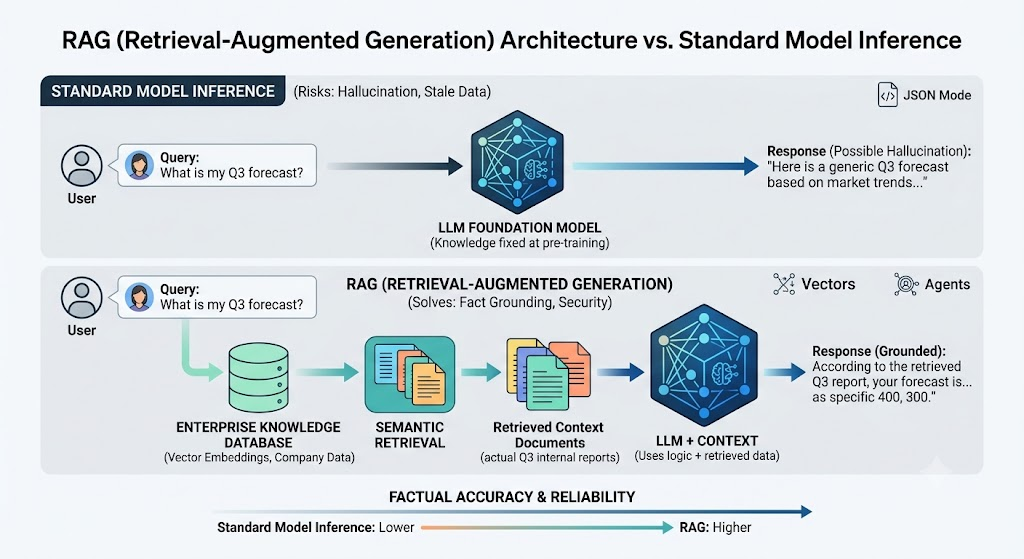
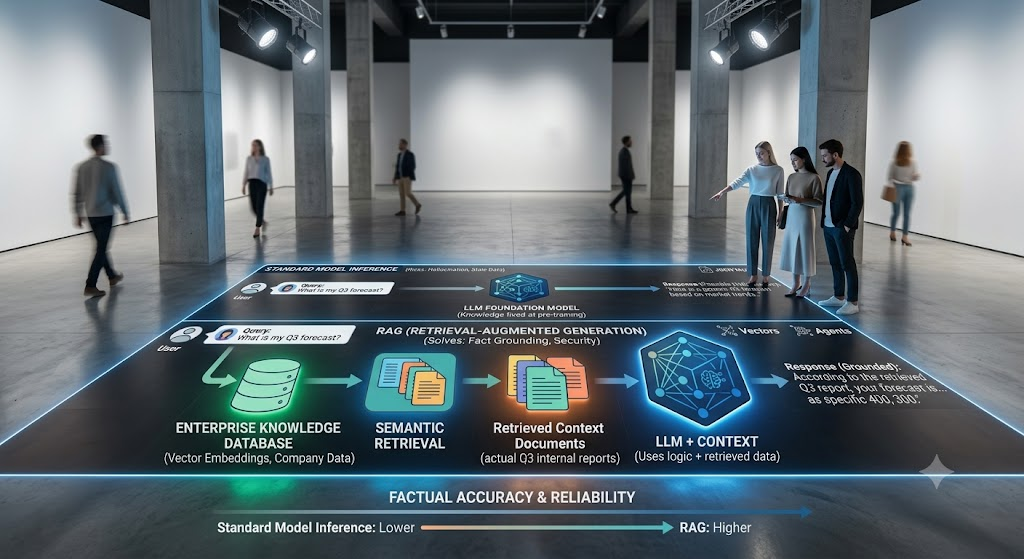
- The Solution: Implement Retrieval-Augmented Generation (RAG) backed by internal vector databases.
- Instead of relying on the model’s memory, retrieve verified documents from a vector database and force the LLM to answer only using the provided context window. Combine this with low temperature settings.
Problem 2: Context Degradation (“Lost in the Middle”)
- The Root Cause: While modern models boast context windows of 128K to 2M+ tokens, retrieval quality degrades when crucial instructions are buried deep within long inputs.
- The Solution: Structure system prompts using XML tags (<context>, <instructions>, <constraints>). Utilize advanced prompt engineering techniques to place mission-critical instructions at the very beginning and very end of your prompt payload to exploit positional bias.
Problem 3: Data Privacy & Compliance
- The Root Cause: Sending proprietary code or personal customer data over standard public API endpoints creates data leakage risks and severe AI security vulnerabilities.
- The Solution: Utilize Enterprise API SLAs (which explicitly exclude user data from training pipelines), deploy models within dedicated cloud tenants (AWS Bedrock, Azure OpenAI), or run Open-Weight Models on private infrastructure.
Operational Takeaway
Large Language Models excel as flexible logic engines rather than authoritative knowledge vaults. By implementing robust prompt architecture, integrating RAG for factual grounding, and choosing the appropriate open or closed infrastructure, organizations can reliably deploy AI systems that solve real business problems.
Enterprise FAQ
1. How do developers prevent LLM API costs from scaling out of control?
Cost management relies on semantic caching (storing and reusing outputs for similar user queries), utilizing smaller/distilled models for basic routing tasks, and strict token limits on input payloads.
2. What is fine-tuning, and when is it necessary over prompt engineering?
Fine-tuning updates a model’s internal weights using custom training pairs. It is rarely needed for factual knowledge injection (which RAG handles better). Instead, fine-tuning is best used to enforce strict output formats, distinct brand voices, or domain-specific code styles.
3. Can LLMs be integrated directly into legacy software architectures?
Yes. Modern LLMs support JSON Mode / Structured Outputs and function-calling. This allows the LLM to output clean data payloads (like valid JSON) that can trigger traditional microservices, database transactions, or external APIs directly.
4. What is the difference between latency and throughput in LLM applications?
Latency measures the time it takes to receive the first token (Time-to-First-Token or TTFT), which directly impacts user chat responsiveness. Throughput measures the rate of tokens generated per second (tokens/sec), which matters for background batch processing, offline summarization, and data processing pipelines.
5. How do open-weight models compare to closed API models in enterprise security?
Open-weight models (like Meta’s Llama family) offer complete data sovereignty because they can be hosted entirely inside air-gapped private clouds without transmitting data to third parties. Closed API models require relying on contractual SLAs to guarantee data privacy, but offer zero infrastructure overhead and higher baseline reasoning performance out of the box.