
What Is Graphify? The Code Knowledge Graph for AI Assistants
Published on Recently
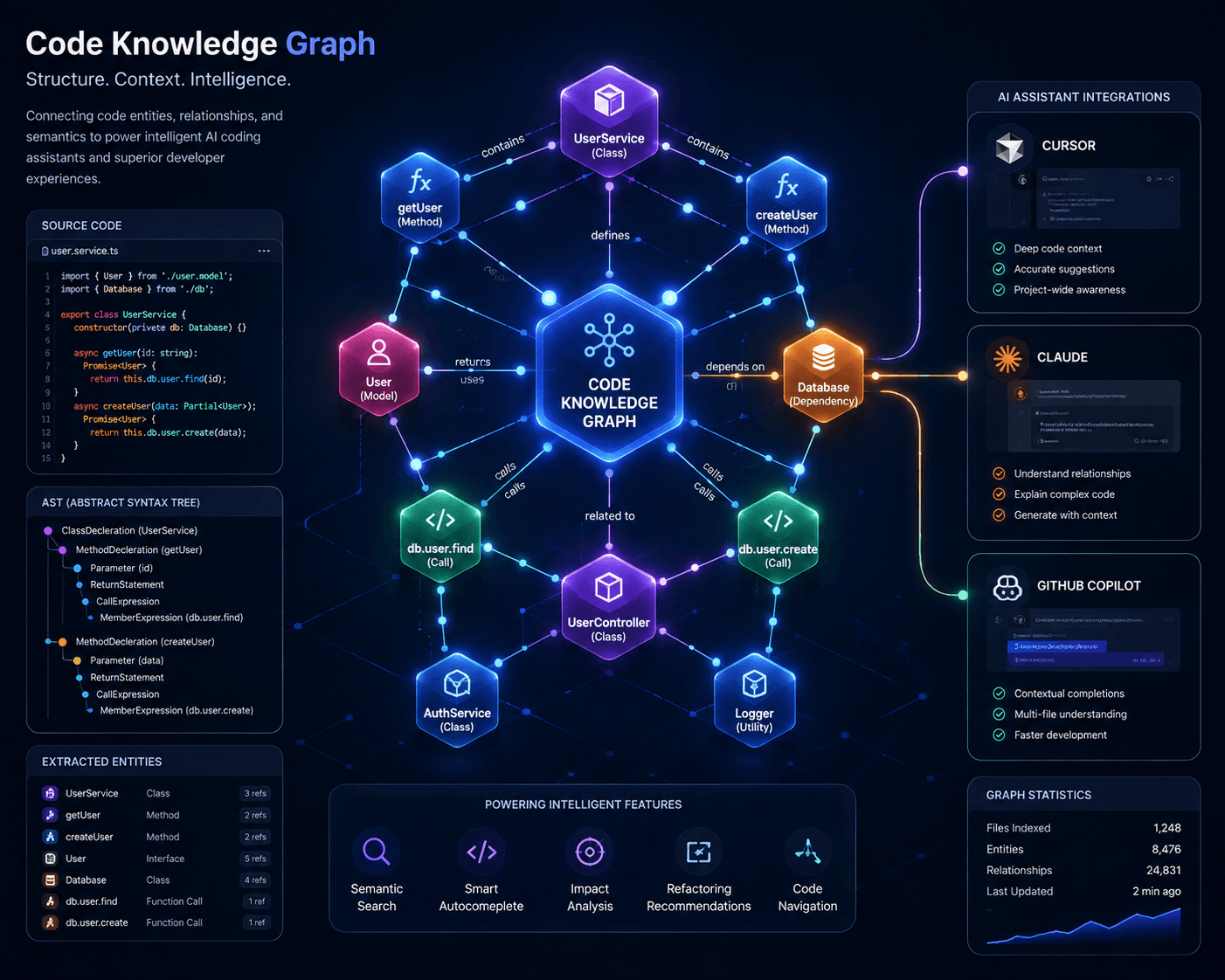
What Is Graphify? The Code Knowledge Graph for AI Coding Assistants
Graphify is an open-source, on-device tool that transforms your codebase into a structured knowledge graph for AI coding assistants. Instead of relying on fuzzy vector search (RAG) or basic text grepping, it maps explicit relationships like function calls and imports, allowing AI to traverse real code paths with precise file-and-line citations.
If you are a developer frustrated by AI assistants that hallucinate, lose structural context, or burn through token limits, Graphify provides a deterministic, auditable alternative.
The Real Problem Graphify Solves for Developers
When working with large codebases, developers frequently face a few common frustrations with AI coding tools:
- Lost Context: Traditional Retrieval-Augmented Generation (RAG) breaks code into fuzzy text chunks. This severs the structural links between files, making it hard for AI to answer multi-hop questions like, "What breaks if I refactor this function?"
- High Token Costs: To compensate for poor retrieval, AI assistants often read entire files into their context window, driving up latency and API costs.
- Privacy Risks: Many code-indexing tools require uploading your proprietary source code to third-party servers for embedding and storage.
- Unverifiable Answers: AI responses often lack clear provenance, leaving developers to manually verify if the suggested code changes are actually safe.
Graphify addresses these issues by shifting from "guessing which text chunks are relevant" to "traversing a verified map of your code."
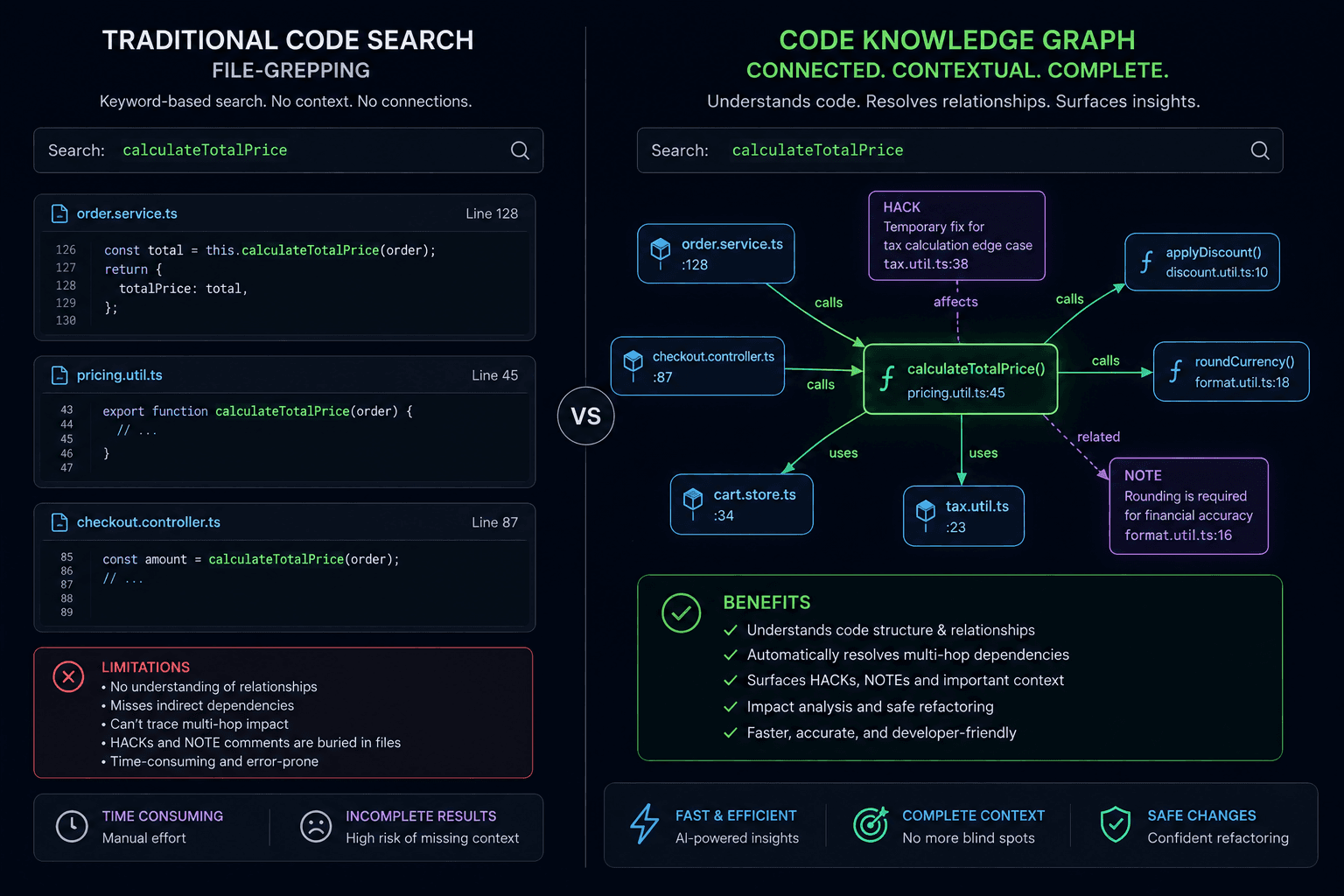
How Graphify Works: A 3-Step On-Device Process
Graphify is designed to be lightweight and frictionless. It operates entirely on your local machine through a simple three-step workflow:
Install the Skill: Run a single command (like /graphify .) in your preferred AI coding assistant. Graphify registers itself as a skill or Model Context Protocol (MCP) server without requiring new extensions or accounts.
Map the Codebase: Graphify uses tree-sitter to parse your source code locally. It extracts functions, classes, imports, and calls into nodes and edges, generating three local files: graph.json, graph.html, and a GRAPH_REPORT.md.
Query, Don’t Grep: Instead of searching raw text, your AI assistant queries the graph. For example, asking "Who owns the billing service?" returns a precise, two-hop path with citations, rather than a wall of unrelated text.
You can explore the setup process in the Graphify Quickstart Documentation or view the source code on the Graphify Official GitHub Repository.
Graphify vs. RAG: Why Knowledge Graphs Beat Vector Search
A common myth in AI development is that vector databases and RAG are the ultimate solution for codebase context. While RAG excels at fuzzy semantic search over large volumes of prose, it struggles with the strict, logical dependencies of code.
Feature
Traditional RAG / Vector Search
Graphify Knowledge Graph
Retrieval Method
Fuzzy top-k chunk similarity (embeddings)
Explicit traversal of typed, directed edges
Context Retention
Loses structural links between chunks
Preserves multi-hop relationships (calls, imports)
Answer Provenance
Opaque similarity scores
Clear tags: EXTRACTED (parser-verified), INFERRED, or AMBIGUOUS
Token Efficiency
High (reads entire files to find context)
Low (pulls only the relevant nodes and edges)
This structural advantage aligns with broader industry research, such as Microsoft’s GraphRAG project, which demonstrates that layering knowledge graphs over retrieval significantly improves an AI’s ability to reason over complex, interconnected data.
Key Benefits for Development Teams
- Drastically Reduced Token Usage: By querying a map instead of reading the entire territory, users report significantly lower token consumption compared to traditional file-grepping methods.
- Faster Onboarding: New engineers can ask high-level architectural questions and receive guided paths through the code, complete with linked NOTE or HACK comments, bypassing days of manual exploration.
- Verifiable Privacy: Because parsing happens locally via deterministic AST (Abstract Syntax Tree) extraction, no telemetry is collected, and no source code is uploaded to external servers.
- Better PR Reviews: The graph can be used to triage CI failures, assess merge-conflict risks, and understand the blast radius of proposed changes.
Frequently Asked Questions
What AI coding assistants work with Graphify?
Graphify integrates seamlessly with 17+ AI coding assistants, including Cursor, GitHub Copilot, Claude Code, Gemini CLI, and Aider. It works via a simple /graphify skill or by connecting to its local MCP server.
Does my code leave my machine when using Graphify?
No. Graphify is designed for on-device privacy. It parses code locally using tree-sitter grammars, and the resulting graph is stored in local files on your disk. Nothing is uploaded to Graphify servers.
Why do I need a graph if my editor already has "Go to Definition" (LSP)?
Language Server Protocol (LSP) tools are excellent for single-hop queries, like finding where a symbol is defined. However, a knowledge graph answers multi-hop, cross-file questions (e.g., tracing how a configuration file ultimately impacts a database schema), providing persistent, queryable context that LSP cannot.
Can Graphify understand non-code files like documentation or SQL schemas?
Yes. While code is parsed deterministically via tree-sitter, Graphify can optionally use your configured local or remote LLM to read and connect non-code assets (like PDFs, docs, or Terraform files) into the graph, clearly labeling these connections as INFERRED.
Conclusion
Graphify represents a practical evolution in how developers interact with AI coding assistants. By replacing fuzzy text retrieval with a structured, on-device knowledge graph, it gives AI the explicit context it needs to reason accurately about your codebase. The result is fewer hallucinations, lower token costs, and answers you can actually trust and audit.
If you are looking to ground your AI assistant in reality rather than probability, mapping your repository with Graphify is a highly effective, privacy-first first step.