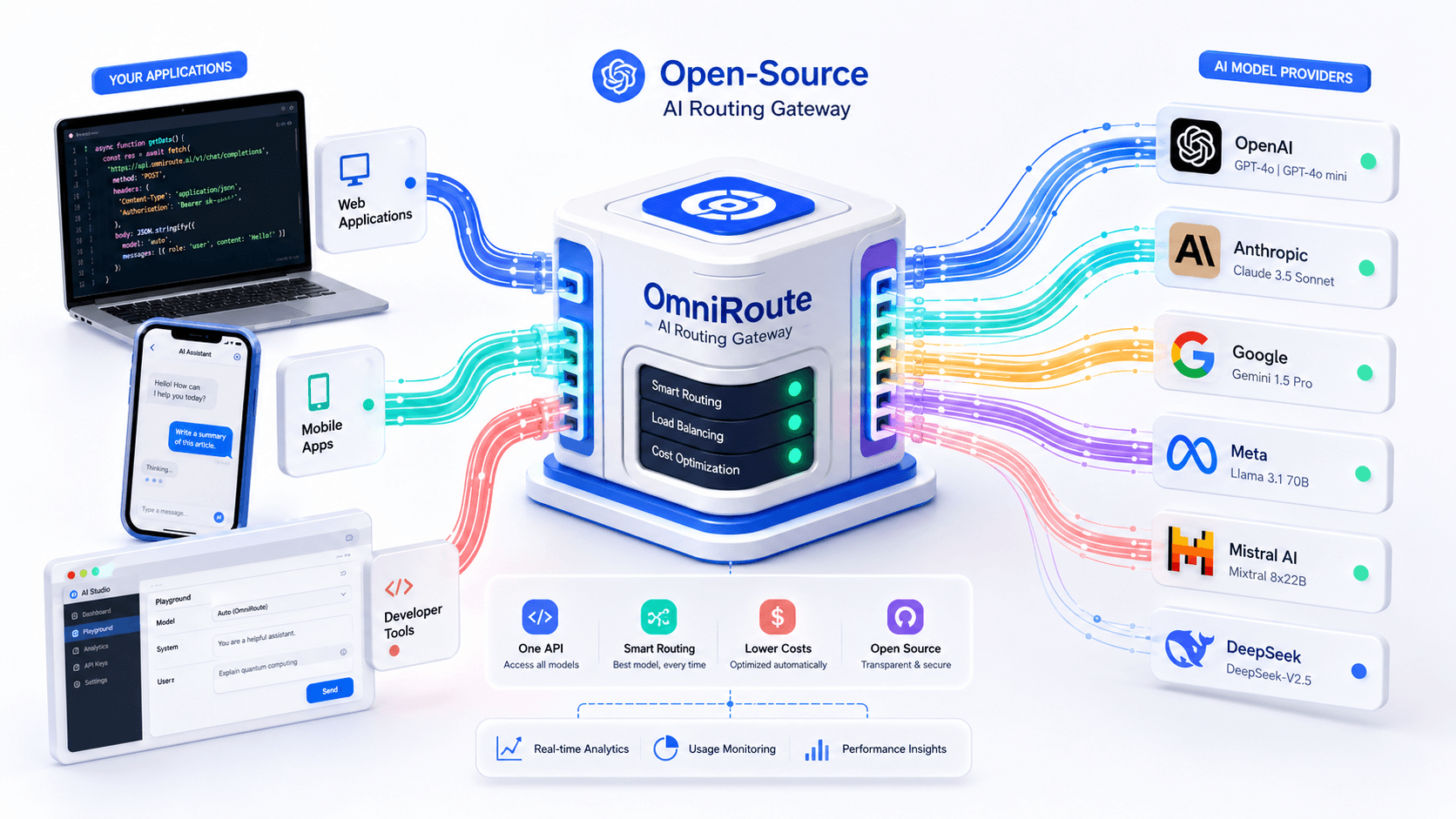
OmniRoute is a free, open-source AI gateway and local routing dashboard that gives developers a single OpenAI-compatible endpoint to access hundreds of AI providers. Instead of juggling multiple SDKs, managing dozens of API keys, or hitting frustrating rate limits, OmniRoute intelligently routes your requests, ensures transparent fallbacks, and significantly reduces token costs. If you are building AI applications and need a resilient, cost-effective way to manage LLM traffic, this guide explains exactly how OmniRoute solves that problem.
What Is OmniRoute and Why Do Developers Need It?
If you are developing AI-powered software, you have likely faced the "API bottleneck": sudden rate limits, unpredictable pricing, or provider downtime that breaks your application. OmniRoute solves this by acting as a local-first middleware.
Rather than hardcoding your app to a single provider like OpenAI or Anthropic, OmniRoute catalogs hundreds of free-tier and paid AI providers, allowing your application to communicate through one unified /v1/* endpoint. This architecture means you avoid vendor lock-in and keep your application running smoothly, even if one primary provider experiences an outage.
Key Features That Solve Real AI Development Problems
OmniRoute is built with specific, practical features designed to address the daily frustrations of AI engineers, indie hackers, and startup CTOs:
- Quota-Aware Auto-Fallback: If your primary AI model hits a rate limit or fails, OmniRoute automatically and seamlessly reroutes the request to a configured backup provider without returning an error to your end user.
- Advanced Token Efficiency: The gateway includes built-in compression techniques (such as RTK+Caveman compression) that can reduce token usage by 15% to 95%, directly lowering your monthly API bills.
- Broad Ecosystem Compatibility: It supports over 339 providers, integrates with 95+ Model Context Protocol (MCP) tools, and works seamlessly with popular AI coding assistants like Cursor, Cline, and Claude Code.
- Agent-to-Agent (A2A) Support: Newer versions include OmniConductor for inbound A2A delegation, future-proofing your stack for complex multi-agent workflows.
The Security Reality: Are Free AI Gateways Safe?
A common misconception in the AI development community is that "free" AI routing tools are insecure or act as data-harvesting traps. It is crucial to distinguish between managed SaaS routers and local-first open-source tools.
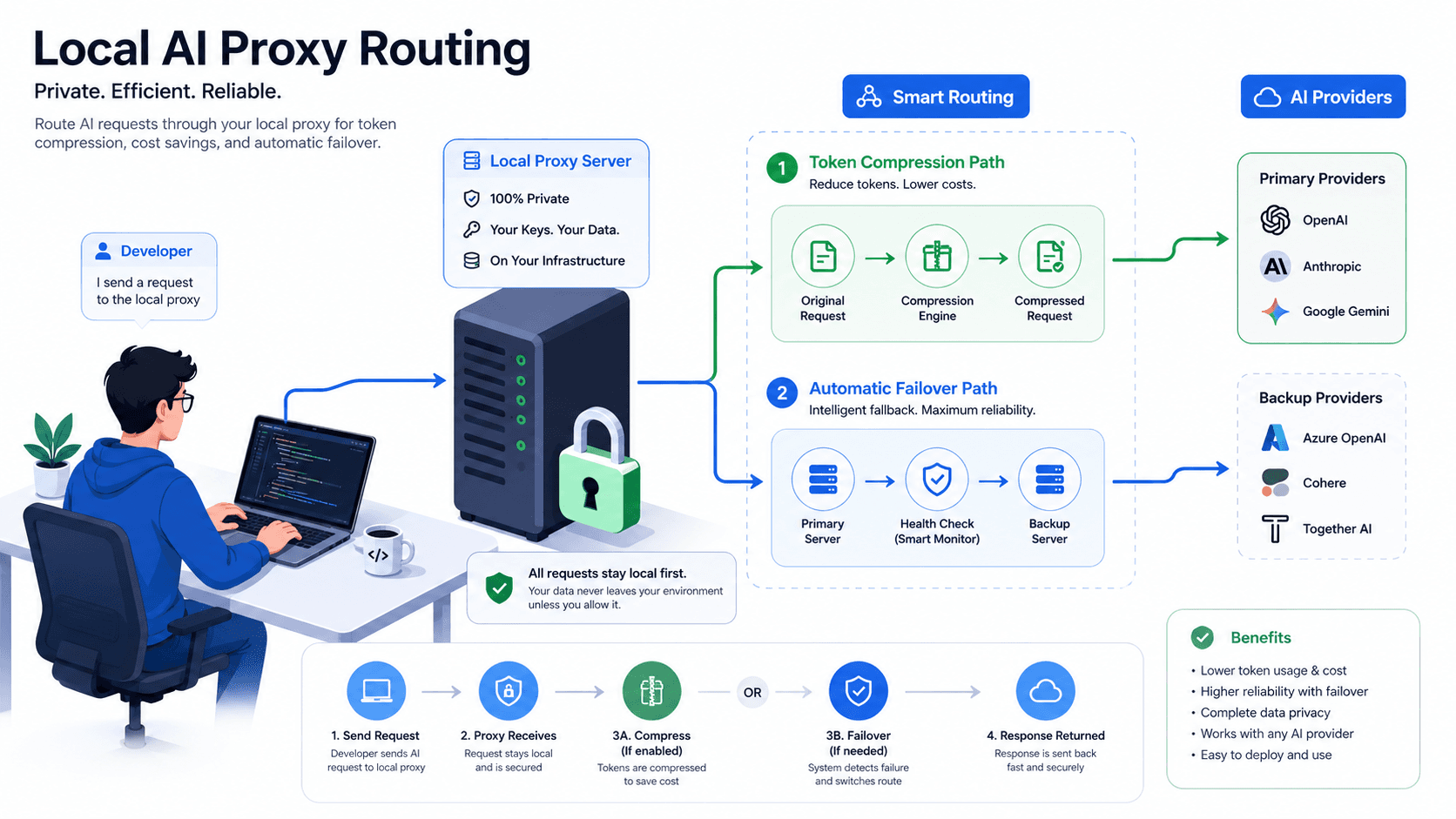
OmniRoute is an MIT-licensed project designed to run entirely on your own infrastructure. This means you are not sending your proprietary prompts or sensitive API keys to a black-box third-party server. You maintain complete control over your data, making it a highly viable option for developers who need to adhere to strict data privacy and compliance standards.
OmniRoute vs. Traditional LLM Gateways
When evaluating routing infrastructure, developers typically compare OmniRoute against tools like LiteLLM or managed services like OpenRouter.
- Deployment Model
- OmniRoute: Local-first, edge-compatible dashboard on your own setup.
- LiteLLM: Self-hosted or enterprise proxy server via Docker/Kubernetes.
- OpenRouter: Fully managed cloud-hosted SaaS platform.
- Core Focus
- OmniRoute: Free-tier optimization and prompt cost reduction using token compression.
- LiteLLM: Enterprise governance, centralized key management, and standard proxying.
- OpenRouter: Cloud convenience and single-key access to hundreds of models.
- Data Privacy
- OmniRoute: 100% on-premise; keys and prompt data never hit third-party servers.
- LiteLLM: Self-hosted architecture offering total internal traffic control.
- OpenRouter: Traffic routes through third-party cloud servers.
OmniRoute occupies a unique, highly practical niche: it is a fast, Next.js-based local dashboard with edge deployment capabilities. It is specifically optimized for developers who want to maximize legitimate free-tier combinations, utilize advanced token compression, and maintain absolute data privacy without relying on a third-party SaaS middleman.
Quick Start: How to Set Up OmniRoute in Minutes
Getting started with OmniRoute is designed to be frictionless, even if you are not a DevOps expert. Here is the standard workflow:
Install OmniRoute: You can install it via npm, run it as a Docker container, or use community helper scripts for environments like Proxmox VE.
Start the Gateway: Launch the local dashboard to access the unified routing interface.
Connect Providers: Add your existing API keys or enable supported free-tier providers directly within the dashboard settings. (For more strategies on maximizing these options, check out our comprehensive guide to free LLM APIs).
Update Your App: Point your application’s LLM calls to OmniRoute’s local OpenAI-compatible endpoint (e.g., http://localhost:3000/v1).
For detailed, step-by-step instructions, refer to the OmniRoute Quick Start documentation.
Frequently Asked Questions
Is OmniRoute safe to use with proprietary company data?
Yes. Because OmniRoute is an open-source, local-first gateway, you host it on your own machine or private server. Your data and API keys do not get sent to a third-party routing company, giving you full control over security and compliance.
Can I use OmniRoute with AI coding assistants like Cursor or Claude Code?
Absolutely. OmniRoute is explicitly designed to integrate with tools like Cursor, Cline, and Claude Code by exposing a standard OpenAI-compatible endpoint that these tools already know how to communicate with.
How does OmniRoute actually reduce API costs?
It reduces costs in two ways: by intelligently stacking and routing to legitimate provider free tiers, and by utilizing token compression technologies that drastically reduce the number of tokens consumed per request.
Do I need to know Next.js to install and run it?
No. While the dashboard is built on Next.js, you do not need to write any frontend code. You can deploy it instantly using pre-configured Docker images or community installation scripts.
Conclusion
OmniRoute is more than just a routing tool; it is a strategic advantage for developers building resilient, cost-effective AI applications. By consolidating hundreds of providers into one secure, local endpoint, it eliminates the friction of rate limits, unexpected costs, and vendor lock-in. Whether you are an indie hacker optimizing a hobby project or a startup scaling its AI infrastructure, OmniRoute provides the control, transparency, and reliability you need. Explore the official OmniRoute GitHub repository or visit the official OmniRoute website to start routing smarter today.